Evidence guide
Do Memory Supplements Work? What the Research Actually Shows
Do memory supplements work? For most products, nobody can say yet. The National Institute on Aging says no vitamin or supplement is currently recommended for preventing cognitive decline, and a Cochrane review of vitamin and mineral trials found no clear help for thinking skills. HoneyPezil has seven printed label lines and no published trial of its own.
- NIA positionNo supplement recommended
- HoneyPezil trialsNone found
- Label lines7, all with amounts
Written by the HoneyPezil label deskUpdated
The short answer01
Do memory supplements work?
Do memory supplements work? The honest answer is that the research has not shown it for any supplement sold for that purpose. The best public guidance from health agencies is cautious, and it is worth reading before you spend money.
The National Institute on Aging says that at this time no vitamin or supplement is recommended for preventing cognitive decline (NIA, Cognitive health and older adults). The Global Council on Brain Health, a group of scientists and health professionals, could not endorse any ingredient, product or formula sold for brain health (Global Council on Brain Health, Brain health supplements).
That does not mean every supplement is proven useless. It means the studies are small, short, seller-funded, or about doses that do not match a bottle. A gap in the evidence is a reason for caution, not a verdict.
If you are worried about your own memory or a parent's, a supplement is not the first step. A doctor's visit is. Treatable causes are common, and a visit can find them (Mayo Clinic, Memory loss: when to seek help).
What the experts say02
What do health agencies say about memory supplements?
Four public sources give the clearest picture, and all four are cautious.
Cochrane pooled eight randomized trials of vitamin and mineral supplements in people with mild memory and thinking problems. It found no clear help in the B-vitamin trials. Niacin was not covered (Cochrane 2018, Vitamin and mineral supplements and thinking skills). The National Center for Complementary and Integrative Health reached a similar view on B6, B12 and folic acid in adults 50 and older, and said evidence for ginkgo and curcumin is limited or inconclusive (NCCIH, Supplements and cognitive function).
| Source | What it says | What it does not say |
|---|---|---|
| National Institute on Aging | No vitamin or supplement is currently recommended for preventing cognitive decline | It does not say every supplement has been tested |
| Global Council on Brain Health | Could not endorse any brain health supplement; be skeptical of packaging claims | It does not rule out future findings |
| Cochrane review (2018) | No clear help for thinking skills from the vitamin and mineral trials pooled | It did not cover niacin or amino acids |
| NCCIH | Short-term B6, B12 and folic acid did not help thinking; ginkgo and curcumin evidence is limited | It does not discuss arginine or niacin |
Why proof is hard03
Why is it so hard to show that a memory supplement works?
It is hard because memory changes slowly, varies from person to person, and depends on sleep, mood, medicines and health. A fair test needs many people, a placebo group and a long follow-up.
Most supplement studies fall short in one of those ways.
Small and short
One trial on arginine in 19 older adults with heart risk lasted four days. Its authors reported that arginine did not help and worsened some measures (Beckman 2018, Arginine and executive function in older adults).
A different product
A trial that found faster times on one mental test used arginine silicate at 1,500 mg in healthy young men. It was company-funded and tested a different compound (Kalman 2016, Arginine silicate and mental tests).
Food is not a capsule
A study of older adults linked niacin from food with a slower yearly decline on thinking tests. It was observational and does not show a capsule does the same (Morris 2004, Dietary niacin and cognitive decline).
Words on a bottle add to the confusion. The FDA does not approve supplements before they are sold (FDA, Q&A on Dietary Supplements). A maker may print a structure or function claim if it has evidence and adds the disclaimer that the FDA has not evaluated it (FDA, Structure/function claims).
How to read a label04
How can you check a memory supplement label?
You can check a memory supplement label in five steps: read the amounts, compare them with studied doses, look for what is missing, check your medicines, and ask who stands behind the claim.
Find every amount
A "proprietary blend" hides how much of each ingredient is inside. Separate amounts let you do the arithmetic.
Compare with studies
Look up what dose a study used. A big gap means the study does not describe your capsule.
Look for what is not printed
Forms, shares of a blended line and the maker's name are often missing.
Check your medicines
Some ingredients interact with common prescriptions. A pharmacist can check in minutes (NCCIH, Using Supplements Wisely).
Ask who tested it
No lab report or trial means no proof from the maker.
Our supplements and medicines guide covers the fourth step in more detail.
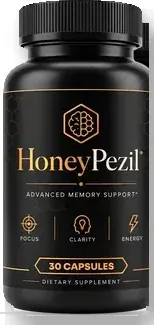
HoneyPezil: 2, 3 or 6 bottles30 capsules a bottle · 30 days at 1 a day · 60-day money-back guarantee
See packsThe HoneyPezil label05
Where does HoneyPezil fit in the evidence?
HoneyPezil is a dietary supplement in capsule form whose front reads "Advanced Memory Support*". No published study tests the product, and each label amount sits far below the amounts used in the studies we found.
Per capsule the label prints niacin 7.5 mg NE, calcium 18 mg, L-arginine 200 mg, L-arginine AKG 200 mg, L-citrulline HCl 100 mg, L-citrulline malate 100 mg and beta alanine 40 mg. The arginine lines add up to at most 400 mg and the citrulline lines to at most 200 mg, because the label does not say how much of the AKG and malate lines is the amino acid itself.
Studies we found used far larger amounts, mostly for exercise: 4 to 6 g a day of beta-alanine (Trexler 2015, ISSN position stand: Beta-alanine) and up to 6 g a day of citrulline (NIH ODS, Exercise and athletic performance supplements). We found no memory trial at the label amounts. That is a research gap, not a finding that the capsule fails. The full numbers are on the label vs studies page.
7 linesone capsule a day, 30 a bottle; every amount printed, no proprietary blend
- L-arginine: base + AKG (at most)400 mg · ref 1,500
- L-citrulline: HCl + malate (at most)200 mg · ref 6,000
- Beta-alanine40 mg · ref 4,000
- Niacin7.5 mg · ref 16
- Calcium18 mg · ref 1,300
Per capsule on the labelAmount a study or an authority used or set (low end)
Log scale: each step to the right is ten times more. A marker far to the right of the bar means the label holds much less than that reference. (Kalman 2016, Arginine silicate and mental tests) (NIH ODS, Exercise and athletic performance supplements) (Trexler 2015, ISSN position stand: Beta-alanine) (NIH ODS, Niacin) (NIH ODS, Calcium)

The claims vs evidence page sets each seller claim next to its sources.
Before you buy06
Should you try a memory supplement?
Whether to try one is your decision, best made with your doctor or pharmacist. The label itself says people with a known medical condition, pregnant or nursing mothers and anyone under 18 should consult a physician first.
Talk to a clinician first if any of these applies to you. The who it is for page has a nine-question check.
- You take nitrates, an erection medicine, blood pressure medicine, diabetes medicine or a blood thinner.
- You have had a heart attack, or you have a known medical condition.
- You are pregnant, nursing or under 18.
- Memory trouble is getting in the way of daily life.
Keep taking prescribed medicine exactly as directed. Never stop or change it because of a supplement.
What helps07
What can you do for your memory today?
You can start with habits and a check-up. NIA lists regular activity, 7 to 9 hours of sleep and staying socially engaged, and Mayo Clinic adds staying organized and reviewing medicines (NIA, Cognitive health and older adults) (Mayo Clinic, 7 memory tips).
See a doctor if forgetfulness lasts more than a few weeks or gets in the way of daily life. Bring a family member or friend, and bring every medicine and supplement you take. Do not use a supplement as a reason to postpone that visit (NCCIH, 7 things to know about supplements and memory).
- Read habits for memory for a simple weekly plan.
- Read when to see a doctor for warning signs.
- Chest pain, a drooping face, weak arm, slurred speech or sudden confusion: call 911 (CDC, Stroke signs and symptoms) (CDC, Heart attack signs).
FAQ08
HoneyPezil questions people ask
Are memory supplements effective?
Evidence for most memory supplements is weak or missing. NIA says no vitamin or supplement is currently recommended for preventing cognitive decline, and Cochrane found no clear help from the vitamin and mineral trials it pooled. A single product may still have a trial we did not find.
Do brain supplements really work?
No public source shows that brain supplements work as marketed. The Global Council on Brain Health could not endorse any brain health supplement. Studies on single ingredients use different doses and groups from retail capsules, so they cannot be applied directly.
What is the best supplement for memory?
No agency we read names a best one. NIA recommends none, and the Global Council on Brain Health could not endorse any. Habits such as activity, sleep and time with others have clearer backing, and a doctor can check treatable causes.
Does HoneyPezil have clinical trials?
We found no published trial of HoneyPezil or of its exact seven-line formula. We also found no memory trial at the label amounts for arginine, citrulline or beta-alanine. The front line, "Advanced Memory Support*", leads to an FDA statement.
Can a supplement replace a doctor's visit for memory problems?
No. NCCIH advises against using supplements as a reason to postpone seeing a provider about memory loss. Treatable causes such as medicines, sleep apnea, thyroid problems and low vitamin B12 can only be found by testing.
Are memory supplements safe to take with medicine?
Not always. Arginine can add to the effect of nitrates, erection medicines and blood pressure medicine, and may affect blood thinners and diabetes medicine. Ask your doctor or pharmacist before you start, and keep taking prescribed medicine as directed.
Who wrote this09
Written and reviewed by
Pages built from the label, the brand panels and linked NIH, FDA, CDC, FTC and peer-reviewed sources.
Last updated . Read our editorial standards and how we check reviews. This website is the information site for a U.S. stocking partner for HoneyPezil. It is not the manufacturer or the distributor named on the label. We earn money when you buy through our order links.
Keep reading
More about HoneyPezil
U.S. stocking partner for HoneyPezil
Ready to try HoneyPezil?
Check your medicines first, especially nitrates, erection medicines and blood pressure medicine, then pick a pack. One bottle is 30 days at 1 capsule a day; 3 bottles cover 90 days and 6 cover 180. A supplement does not replace a doctor's visit for memory trouble that lasts.
- Secure checkout
- 60-day money-back guarantee
- Ships from the U.S. with tracking